
Seeing Is Believing: The Benefits of Ultrasound for Patients and Providers
Pelvic Ultrasound After Miscarriage: What Doctors Usually Check For
Pelvic Ultrasound After Miscarriage: What Doctors Usually Check For
A miscarriage can leave you with two parallel realities: the emotional punch (often underestimated by everyone except the person living it) and the physical recovery (which can be more complicated than people expect). A pelvic ultrasound after a miscarriage is basically your clinician’s way of doing a careful “status check” to make sure your body is recovering safely—and to spot problems early if it isn’t.
This article is general education, not medical advice. Your exact situation depends on your symptoms, how far along the pregnancy was, and whether the miscarriage happened naturally or with medication/procedure.
Why an ultrasound might be done after a miscarriage
Not everyone needs an ultrasound after a miscarriage. But clinicians commonly order one when:
Bleeding is heavy, prolonged, or returns after slowing down
Pain is worsening instead of improving
There’s fever, foul-smelling discharge, or concern for infection
There’s uncertainty whether the miscarriage is complete
You were treated with misoprostol (medical management) or had a procedure and they want confirmation everything has passed
There was never a confirmed intrauterine pregnancy (important because ectopic pregnancy can mimic miscarriage symptoms)
Guidelines for early pregnancy complications emphasize using ultrasound (and sometimes serial hCG blood tests) to clarify diagnosis and ensure safe follow-up.
What kind of ultrasound is it?
A “pelvic ultrasound” can include:
Transabdominal ultrasound (probe on the lower belly): wider view, less detail early on.
Transvaginal ultrasound (probe inserted vaginally): much clearer detail of the uterus lining and ovaries, especially in early pregnancy and post-miscarriage evaluation. Clinical measurement standards for early pregnancy assessment often rely on transvaginal imaging for accuracy.
The main things doctors usually check
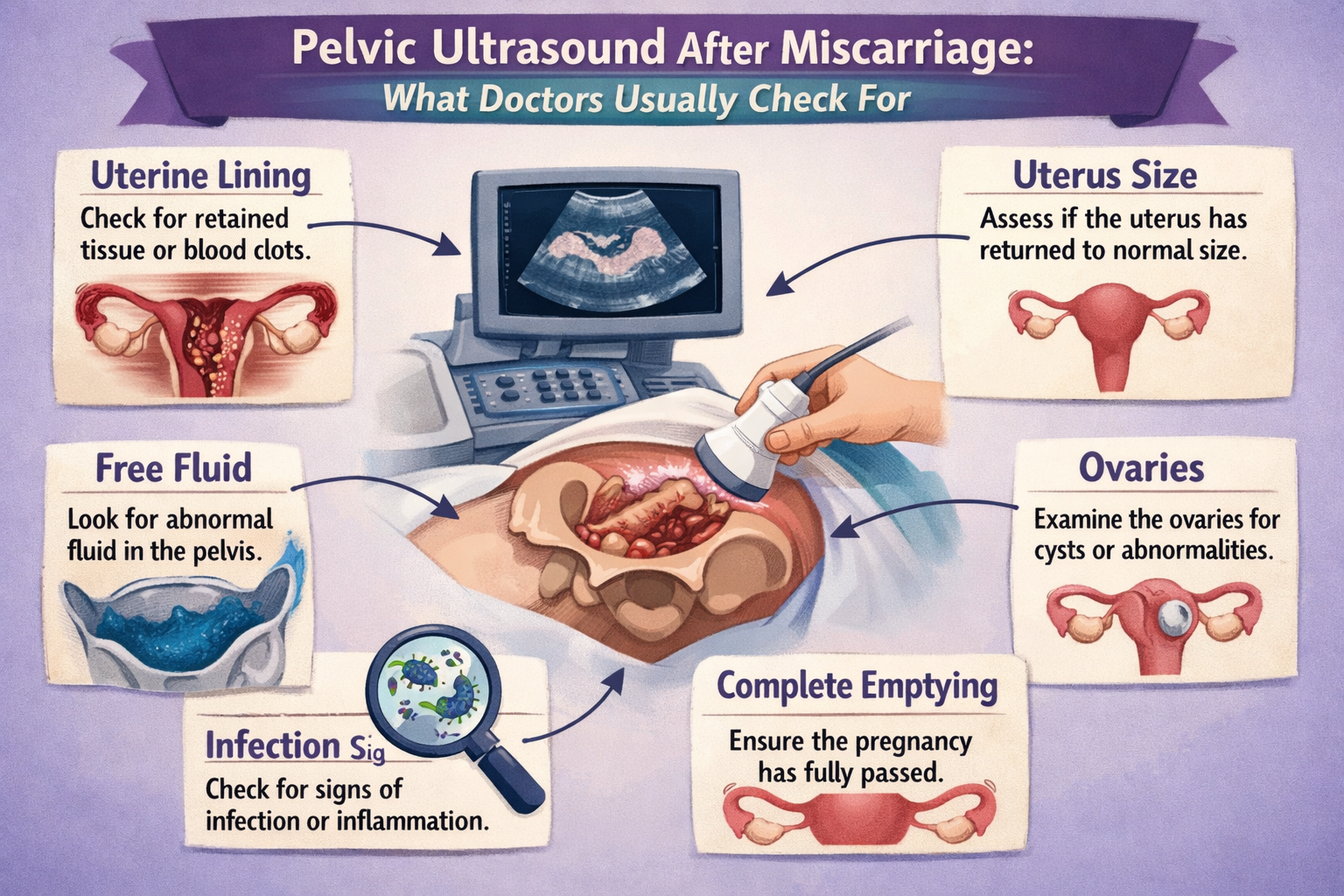
1) Is there retained tissue inside the uterus?
This is the big one. Doctors are looking for retained products of conception (RPOC)—meaning placental and/or pregnancy tissue still in the uterus after a miscarriage.
On ultrasound, they may look for:
A mass inside the endometrial cavity (often the most useful clue)
Thickened, irregular, or “heterogeneous” material in the uterus
Increased blood flow to that area on Doppler (color flow imaging)
One commonly cited finding: an endometrial mass is the most sensitive ultrasound sign for RPOC, and if there’s no mass or fluid and the endometrial thickness is < 10 mm, RPOC is considered extremely unlikely in that study context.
Why this matters: retained tissue can cause ongoing bleeding, cramping, and sometimes infection, and it may change the treatment plan (watchful waiting vs medication vs a procedure).
2) Is it blood clot… or tissue?
After a miscarriage, the uterus can contain blood clots, and clots can look scary on ultrasound.
A common trick clinicians use is Doppler flow:
Tissue is more likely to show blood flow.
Clot is more likely to be avascular (no flow).
But here’s the nuance people miss: absence of blood flow does not rule out RPOC—so ultrasound findings are interpreted alongside symptoms and labs.
3) What does the uterine lining look like?
They’ll assess the endometrium (uterine lining), including:
Thickness
Whether the cavity looks empty
Whether there’s fluid or debris
This helps determine whether the miscarriage appears complete or incomplete—but thickness alone isn’t a perfect yes/no answer, which is why symptoms matter.
4) Could this actually be (or still involve) an ectopic pregnancy?
This is critical when there was no earlier ultrasound proving the pregnancy was inside the uterus.
Clinical guidance warns that even if an ultrasound looks like a “complete miscarriage,” clinicians should remain alert to the possibility of ectopic pregnancy in that scenario.
So they may check:
The fallopian tubes/adnexa for a suspicious mass
The ovaries (including the corpus luteum cyst, which can be normal)
Any free fluid in the pelvis (which can be concerning if significant)
If ectopic pregnancy is on the table, clinicians often combine ultrasound with serial hCG testing rather than relying on one scan.
5) Any signs that suggest infection or inflammation?
Ultrasound cannot “diagnose infection” by itself, but it can show patterns that raise suspicion, especially if you also have fever, uterine tenderness, or foul discharge.
They may look for:
Fluid in the uterine cavity with internal debris
Thickened endometrium
Increased vascularity in/around the endometrium
If infection is suspected, treatment is based on the whole clinical picture (symptoms + exam + labs), not ultrasound alone.
6) Are there other uterine issues that could matter going forward?
Sometimes the ultrasound finds things that didn’t cause the miscarriage but may be relevant later—especially after repeated losses or fertility concerns:
Fibroids (location matters more than size)
Polyps
Uterine shape differences (like a septum)
A routine post-miscarriage scan isn’t always a deep “structural work-up,” but it can point to things worth investigating.
7) Rare but important: molar pregnancy / gestational trophoblastic disease concerns
This is not common, but clinicians stay aware of it. Certain ultrasound patterns plus unusually high or persistent hCG can trigger further evaluation. RPOC references often discuss how vascularity and intrauterine material need careful interpretation because multiple conditions can look similar.
What your ultrasound report language usually means (in plain English)
You might see phrases like:
“No retained products of conception” → uterus looks empty enough; reassuring.
“Thickened endometrium / endometrial stripe” → could be normal recovery, clot, or possible retained tissue; symptoms guide what happens next.
“Heterogeneous material in the endometrial cavity” → mixed tissue/clot appearance; often prompts follow-up.
“Vascular endometrial mass” → more suspicious for retained tissue.
What happens after the scan?
It depends on your symptoms and what the scan shows:
Reassuring scan + improving symptoms → usually watchful waiting.
Possible retained tissue but stable → sometimes medication or a repeat scan.
Clear retained tissue + heavy bleeding/pain → a procedure may be recommended.
Any concern for ectopic pregnancy → closer follow-up with serial hCG and repeat imaging.
When to seek urgent care (don’t “wait it out”)
Get urgent medical attention if you have:
Bleeding that soaks 1 pad per hour for 2+ hours
Severe or worsening one-sided pelvic pain
Dizziness, fainting, shoulder pain
Fever (often ≥ 100.4°F / 38°C) or chills
Foul-smelling discharge
These can signal hemorrhage, infection, or ectopic pregnancy complications—situations where speed matters more than toughness.
What to expect on the day
For transabdominal, you may be asked to have a full bladder.
For transvaginal, you’ll usually be asked to empty your bladder first.
You can ask for a chaperone, ask the tech to explain each step, and request pauses if you feel overwhelmed. None of that is “being difficult.” It’s being a human.
The real truth nobody says out loud
A post-miscarriage ultrasound isn’t just a medical checklist—it’s often the moment your body’s reality gets confirmed on a screen. That can land like closure, or like a second wave of grief. Both are normal. Medical care should be technically excellent and emotionally literate; if you’re not getting both, advocate for yourself or bring someone who will.
For those seeking expert ultrasound services, Atlanta Ultrasound offers quick, efficient, and comprehensive scans. Our team of skilled professionals is dedicated to providing you with the clarity and care you need.
Contact us today to schedule your ultrasound scan and take a decisive step towards understanding your health.
📍 Multiple locations in Metro Atlanta, GA
📞 Contact: 678-590-3300
🌐 Website:www.atlantaultrasound.com
Disclaimer: The content of this blog post, authored by a sonographer, is provided for educational and informational purposes only. It is not intended as medical advice, nor should it substitute for professional medical consultation, diagnosis, or treatment. Always seek the advice of your physician or other qualified health providers with any questions you may have regarding a medical condition or health concerns.