
Seeing Is Believing: The Benefits of Ultrasound for Patients and Providers

Why Ultrasound Images Sometimes Look Unclear (and what you can do about it)
Why Ultrasound Images Sometimes Look Unclear (and what you can do about it)
You came for the cute picture. You got a blurry gray blob that looks like a weather radar map. Annoying? Yes. Normal? Also yes most of the time.
Ultrasound isn’t a camera. It’s sound waves bouncing through layers of tissue and fluid, then getting translated into an image. That means clarity depends on physics, anatomy, timing, and a baby who may be doing Olympic-level acrobatics.
Below are the most common reasons ultrasound images look unclear, especially for pregnancy scansplus practical ways to improve your chances of getting the crispest images possible.
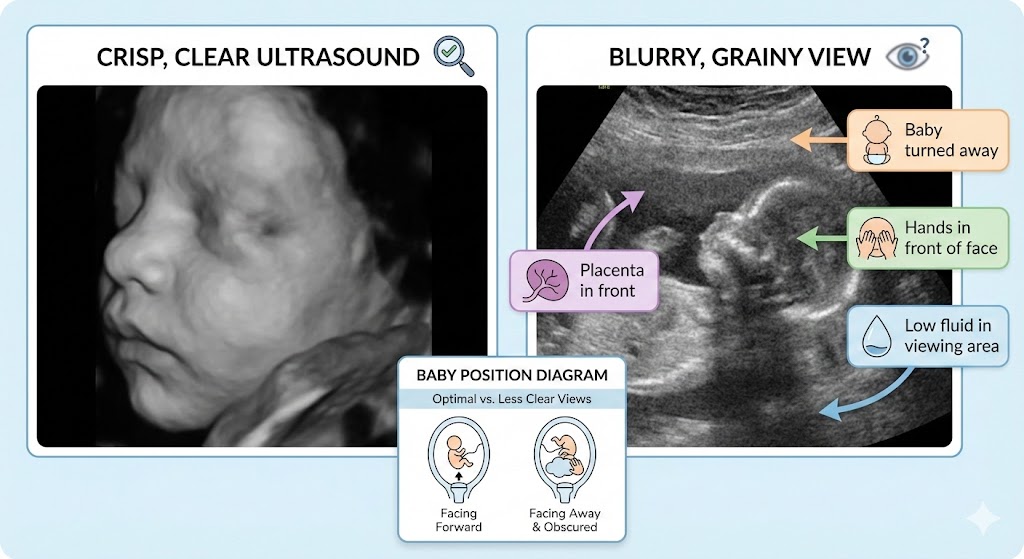
First: what “unclear” actually means
When people say an ultrasound is unclear, they usually mean one (or more) of these:
Blurry edges (baby moved or the angle isn’t great)
Dark shadows blocking parts of the face/body (something is in the way)
Washed-out or grainy image (sound waves are weakening before they return)
Baby’s face isn’t visible (position + placenta + limbs blocking the view)
Most of these are image artifacts, not “something is wrong with the baby.”
1) Baby position: the #1 culprit
Babies don’t pose. They fold, tuck, stretch, hide, and sometimes press their face into the placenta like they’re avoiding paparazzi.
Common bad for photos positions:
Face turned toward your back
Chin tucked into chest
Hands/feet covering face
Baby facing down (toward the spine)
Why it matters: Ultrasound needs a decent “window.” If baby is turned away or blocked, the machine can’t magically see through the obstacle.
What can help:
Change your position (left side, right side, slight tilt)
Short walk, gentle movement
A quick break and re-scan a little later (babies often shift)
2) Gestational age: sometimes it’s just too early
Timing matters a lot, especially for 3D/4D images.
Too early: baby’s features may be small and harder to define
Too late: baby can be cramped, face pressed against the uterus/placenta, less fluid “space” for clear facial images
In general, the “sweet spot” for clear face pictures is often mid-to-late second trimester into early third, depending on baby’s position and other factors.
Real talk: No timing guarantees perfection. It improves odds.

3) Amniotic fluid: your built-in “photo buffer”
Amniotic fluid is a big deal because it helps carry sound waves and creates contrast around the baby.
More fluid around the face/body can improve clarity
Less fluid in the viewing area can make images look flat, shadowy, or unclear
This doesn’t automatically mean there’s a medical issue fluid levels naturally vary. But if a medical concern is suspected, that’s something your healthcare provider evaluates.
What can help (non-medical, practical):
Staying hydrated in the days leading up to your scan can sometimes help overall imaging conditions (it’s not a magic hack, but it doesn’t hurt).
4) Placenta location: the “built-in curtain”
If you have an anterior placenta (placenta positioned toward the front of your uterus), it can sit between the ultrasound probe and the baby.
What that can do:
Make the image look softer or more “muted”
Add shadowing in certain areas
Sometimes block the face depending on baby’s position
This is common and usually not a problem, just an imaging challenge.
5) Body tissue and distance: sound waves lose strength
This is the part nobody says out loud: ultrasound clarity can drop when sound waves have to travel farther. More tissue between the probe and the baby can reduce sharpness and increase “graininess.”
This can be influenced by:
Natural body shape and abdominal tissue
Swelling/bloating
Scar tissue from previous surgeries (can change how waves pass)
Baby’s position deeper in the pelvis
Important: This is not a “you problem.” It’s physics.
What helps:
A skilled sonographer adjusting angles and settings
Patience and repositioning
Sometimes scheduling at a different time (when baby is more cooperative)
6) Baby movement: motion blur is real
If baby is moving, swallowing, stretching, or kicking mid-capture, the image can blur—especially on 3D/4D.
What helps:
Brief pauses to let baby settle
Repositioning you to encourage a change
Giving it time (sometimes baby calms down after a few minutes)
7) Shadowing from bone, hands, or umbilical cord
Ultrasound doesn’t pass cleanly through everything. Bone blocks sound waves and creates shadows. So do certain dense or awkwardly placed structures.
Common blockers:
Hands in front of the face
Feet up by the cheeks
Umbilical cord drifting in the “camera lane”
Skull or ribs casting shadow over nearby areas
This is why you’ll sometimes see half a face and a dark patch over the rest.
8) Equipment settings and technique (yes, this matters)
Even with great conditions, ultrasound needs:
Correct depth and focus
Good angle
Proper gain (brightness) and contrast
A steady hand and time to “hunt” for the best window
A quality facility and experienced sonographer can significantly improve the result—but they still can’t override baby’s position or placenta placement.
How to improve your chances of clearer ultrasound images
Here are realistic, non-mythical things that can help:
Before your appointment
Hydrate well for 1–2 days before (simple, practical).
Avoid heavy lotions/oils on your belly right before the scan (they can interfere with probe contact).
Know your goal: If you want face images, timing and baby’s position matter more than anything.
During your appointment
Be flexible with positioning: side-to-side, slight tilt, sitting up.
Take a short walk if asked.
Be patient: sometimes baby changes position after a few minutes.
If images are still unclear
It’s often worth trying again another day (baby’s position can be totally different).
If this is a medical scan and something couldn’t be seen clearly, follow your provider’s guidance on repeat imaging.
When “unclear” might matter medically
Most “unclear” images are just technical limitations. But if this is a diagnostic scan and the technician/provider says they couldn’t visualize a specific structure, that’s different—they may recommend a repeat scan.
Don’t self-diagnose from a blurry image. Ultrasound interpretation is about trained assessment, not vibes.
FAQ
Is a blurry ultrasound a sign something is wrong?
Usually, no. Most of the time it’s position, fluid, placenta, or physics.
Why does my friend’s ultrasound look so much clearer than mine?
Different week of pregnancy, different baby position, different placenta location, different body tissue, different machine, different day. Ultrasound is wildly dependent on conditions.
Can I “make” my baby move into a better position?
You can encourage changes (walking, changing your position), but you can’t control the baby. Anyone who promises you can is selling fantasy.
What’s the best time for clear 3D/4D images?
Often mid-to-late pregnancy is best for facial features, but there’s no single perfect week for everyone because placenta and position can still block the view.
Bottom line
Ultrasound images look unclear for boring reasons: baby won’t cooperate, something’s in the way, or sound waves are getting weakened. It’s rarely a crisis , just biology doing biology.