
Seeing Is Believing: The Benefits of Ultrasound for Patients and Providers

The Deafening Silence During a Fertility Scan
The Deafening Silence During a Fertility Scan
There’s a moment during IVF that no one really prepares you for.
You’re lying there… staring at the ceiling… listening to the quiet hum of the ultrasound machine.
And the room is silent.
Not peaceful silence.
The kind that makes your thoughts get louder.
What are they seeing?
Are things growing the way they should?
Why isn’t anyone explaining this to me?
If you’ve felt that, you’re not overthinking it.
You’re in the middle of something deeply personal and you deserve to understand it.
What’s actually happening during a fertility monitoring ultrasound
Let’s make this clear, because this is where so many women are left guessing.
During IVF, monitoring ultrasounds (usually transvaginal ultrasounds) are used to track how your body is responding to stimulation medications.
Here’s what’s being looked at:
Follicles (in your ovaries)
Follicles are small, fluid-filled sacs that develop in the ovaries. Each one may contain an egg.
On ultrasound, they are:
Counted
Measured in millimeters
Tracked over time to see how they’re growing
Why it matters:
The size and number of follicles help your care team estimate how many eggs might be retrieved and determine when you’re ready for a trigger shot (the medication that prepares the eggs for retrieval).
Ovarian response to medication
Your ovaries are being stimulated to grow multiple follicles in one cycle.
Ultrasound helps assess:
Whether your ovaries are responding
If the response is slower, expected, or higher than anticipated
Why it matters:
This information helps your provider adjust medication doses if needed and reduce risks like overstimulation.
Endometrial lining (your uterine lining)
This is the inner layer of the uterus where an embryo would implant.
On ultrasound, we assess:
Thickness (measured in millimeters)
Pattern (often described as trilaminar, or layered, when it’s developing well)
Why it matters:
A lining that is developing appropriately is one of several factors that support successful embryo implantation.

One important piece that’s often missing from the conversation
Ultrasound is only one part of IVF monitoring.
Bloodwork, especially hormone levels like estradiol, is typically done alongside these scans.
Together, these give a more complete picture of how your body is responding.
But even knowing that…
you still deserve to understand what’s happening during the scan itself.
So why does it feel so quiet?
In many clinics, the person performing your ultrasound is focused on capturing accurate images and measurements.
They may not always be the one responsible for interpreting or discussing results at that moment.
So the room stays quiet.
Images are taken. Numbers are recorded.
And you’re left in your head, trying to make sense of what you can’t see or don’t fully understand yet.
That silence can feel heavy ..especially when so much is riding on these details.
The part that matters more than people talk about
IVF is not just a medical process.
It’s emotional. It’s physical. It’s layered.
And when you feel like you’re not being talked through what’s happening…
it can make the whole experience feel more isolating than it needs to be.
Wanting clarity is not asking for too much.
Wanting someone to explain your own body to you in real time is valid.
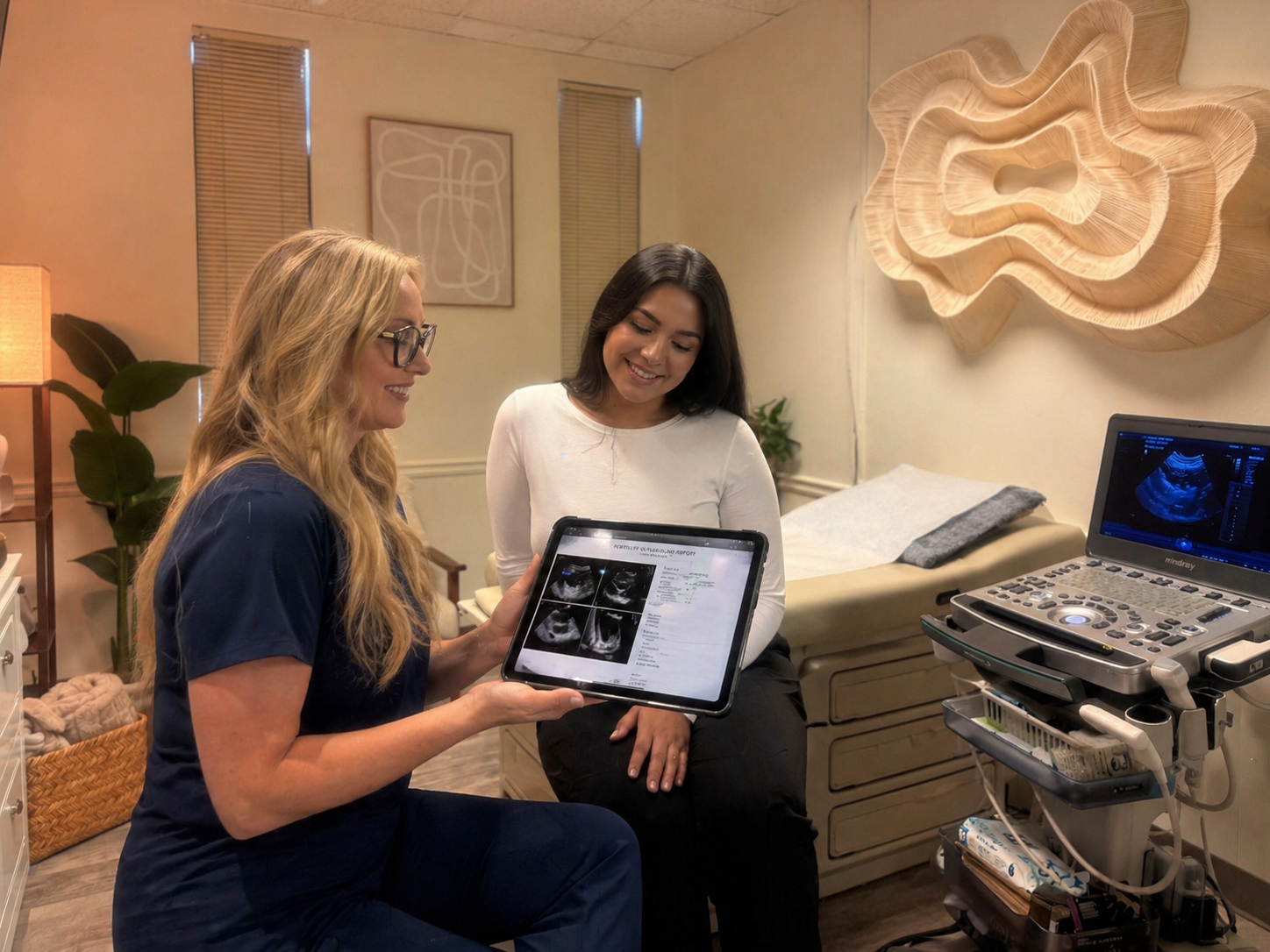
What a more supported experience can look like
Now imagine this:
You walk into a space where the pace is slower.
You’re not one of dozens of patients moving through in a single day — the schedule is intentionally lighter, so there’s time for you.
Time to pause.
Time to ask questions.
Time for someone to explain what’s visible on your scan, in a way that actually makes sense.
Instead of silence, you hear:
“Ok, now we are measuring your follicles so your doctor can track the growth”
“This is your uterine lining : we are going to measure this as well to check the size and also the texture.”
No silent voids.
Just warm, comforting conversations.
(Please note: we cannot diagnose, this will be up to your provider)
If you’re in the middle of IVF and feeling that silence
You deserve more than just being scanned and sent on your way.
At Atlanta Ultrasound, the experience is intentionally different:
Only 8–10 patients per day (instead of high-volume scheduling)
Time to ask questions and learn what’s being seen
A slower, more comfortable pace during your visit
A calm environment with soft music and gentle lighting
No referral needed
Radiation-free imaging
Same-week appointments
Clear, timely answers
Care that feels personal and present
This doesn’t replace your fertility clinic.
It supports you alongside it — so you’re not left sitting in silence, wondering.
You’re allowed to want peace of mind while you’re in the room.
You’re allowed to understand what your body is doing, every step of the way
And you’re definitely allowed to feel like you’re part of the process — not just a patient moving through it.
Your Health, Our Priority
At Atlanta Ultrasound, your health is our top priority. We're here to ensure that you have access to high-quality ultrasound services in a warm and caring environment. Located right here in Atlanta, we’re committed to providing our local residents with the best in health and prevention imaging.
(Important Note: If you are using our clinic as a substitute for an official monitoring appointment, please confirm with your Reproductive Endocrinologist that they accept outside imaging. We will provide you with a comprehensive report to share directly with your provider.)
📍 Multiple locations in Metro Atlanta, GA
📞 Contact: 678-590-3300
🌐 Website: www.atlantaultrasound.com
Disclaimer: The content of this blog post, authored by a sonographer, is provided for educational and informational purposes only. It is not intended as medical advice, nor should it substitute for professional medical consultation, diagnosis, or treatment. Always seek the advice of your physician or other qualified health providers with any questions you may have regarding a medical condition or health concerns.
Do not disregard professional medical advice or delay seeking it based on the information presented here
Ai Disclaimer: This post includes AI-generated content, which helps keep costs low while maintaining quality.