
Seeing Is Believing: The Benefits of Ultrasound for Patients and Providers
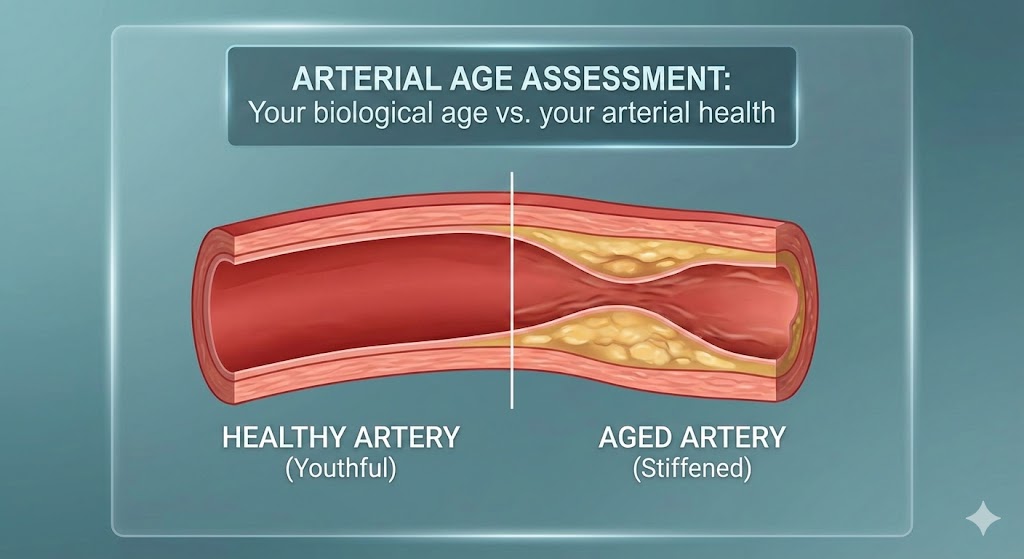
Your Arterial Age: The Heart-Health Number That Can Warn You Before Symptoms Start
Your Arterial Age: The Heart-Health Number That Can Warn You Before Symptoms Start
You know your age. It’s on your ID, your birthday cake, and the little back pain you pretend isn’t real.
But here’s the curveball: your arteries can have an age too and it doesn’t always match the number you celebrate every year.
That “arterial age” (sometimes called “vascular age”) is a simple way of answering a big question:
Are your blood vessels behaving like they belong to someone younger… or someone older?
And that matters, because heart and stroke risk usually doesn’t show up with loud warning signs. It builds quietly.

So what is arterial age, really?
Think of your arteries like flexible, stretchy pipes.
When they’re healthy, they expand and bounce back easily with every heartbeat. That’s what helps blood flow smoothly.
Over time, arteries can:
get stiffer, and/or
build plaque inside the walls
Both of those changes can happen long before you feel anything “wrong.”
Arterial age is basically a way doctors and researchers translate what’s happening inside your arteries into a number that’s easy to understand.
How do people find out their arterial age?
There isn’t just one “arterial age test.” It’s usually estimated using one of these:
1) A test that checks artery stiffness
A common method looks at how fast the pulse from your heartbeat travels through your arteries.
Stiffer arteries = faster pulse wave = older arterial age.
2) A test that checks plaque
One example is a coronary calcium scan, which looks for calcium buildup in the arteries of your heart.
3) An ultrasound of the carotid arteries (neck)
This can show things like:
plaque presence, or
thickening in the artery wall
Different tests show different “chapters” of the same story: how your blood vessels are aging.
Why knowing your arterial age is actually useful
Let’s be honest: most people don’t take heart health seriously until something scares them.
Arterial age can be that reality check without waiting for a crisis.
Here’s why it’s powerful:
1) It can reveal risk before symptoms show up
A lot of cardiovascular issues don’t hurt… until they do.
Arterial age can give you a heads-up early when you still have time to change the direction.
2) It makes the risk feel real
Being told “your blood pressure is a bit high” can feel like background noise.
But hearing, “Your arteries look 10–15 years older than you,” hits different.
That kind of clarity can be the push people need to take action seriously.
3) It helps people in the “gray zone” decide what to do
Some people aren’t clearly “high risk” or “low risk.” They’re in the middle:
borderline cholesterol
family history of heart disease
occasional high blood pressure
feeling fine but worried
Arterial age can help bring more clarity to what your next step should be.
4) It’s not about weight or looks
You can be slim and still have aging arteries.
You can also be plus-sized and have healthier-than-expected vessels.
Arterial age helps separate appearance from what’s actually happening inside your body.
5) It gives you a measurable thing to improve
When used the right way, it can become part of a long-term prevention plan. Not obsession. Not fear. Just awareness and strategy.
If your arterial age is “older,” don’t panic, get serious
This is where people mess up.
They either:
ignore it, or
spiral into anxiety and random supplements
Neither helps.
If your arterial age is higher than expected, it’s not a death sentence. It’s a signal.
The smartest move is to focus on the biggest drivers of artery aging:
Blood pressure control
Lowering inflammation through consistent movement and nutrition
Managing cholesterol
Blood sugar balance
Quitting smoking/vaping
Sleep and stress management (yes, it counts)
And then working with a clinician who helps you turn the information into a real plan—not vague advice.
The bottom line
Knowing your arterial age is like getting a peek under the hood.
It helps you answer one of the most important health questions there is:
Is your body aging on schedule… or running ahead of you?
If it’s ahead, the goal isn’t fear. The goal is control.
Because the earlier you know, the more power you have to change the outcome.